
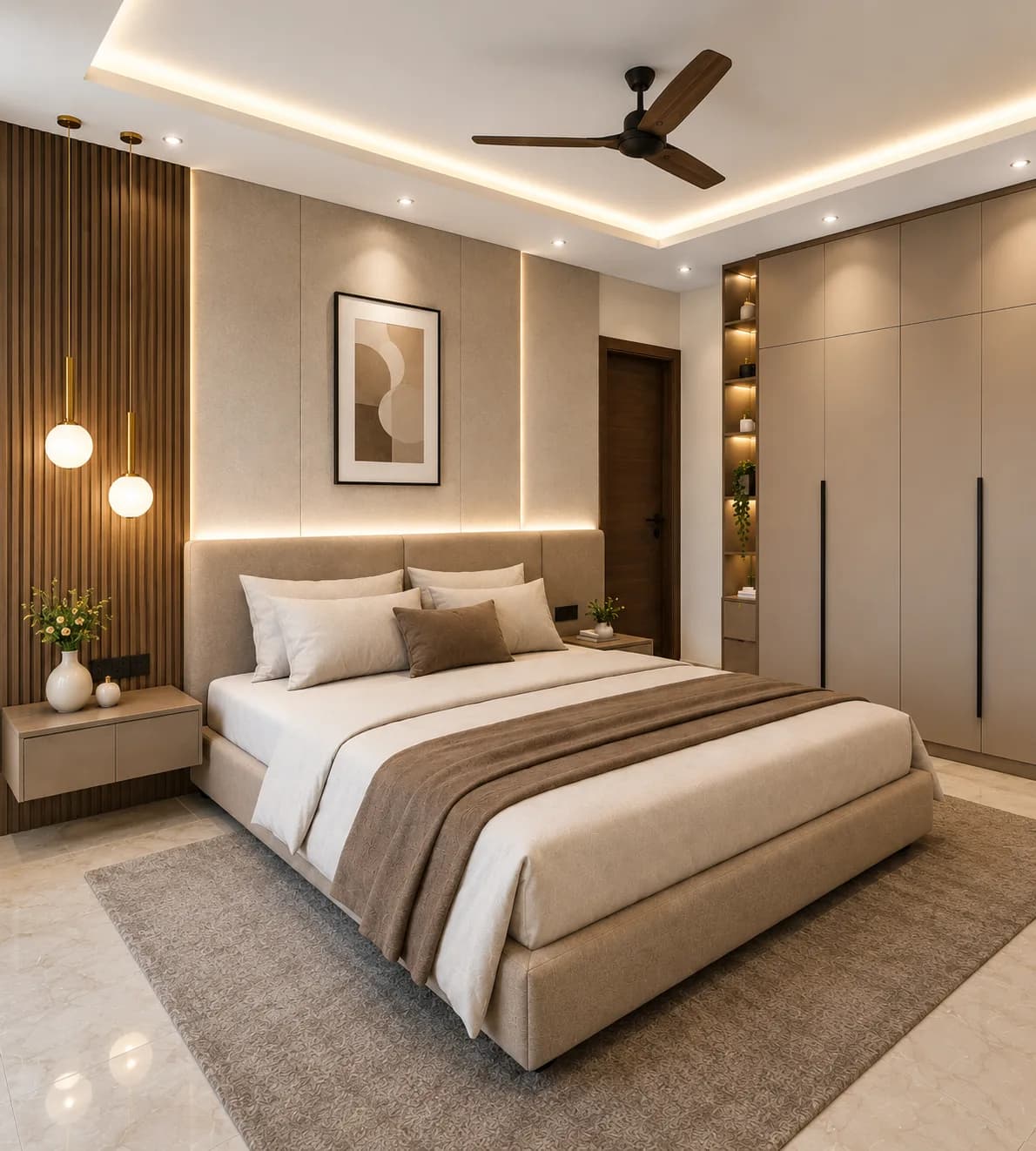
Walk into ten flats in the same Delhi NCR building, and you'll find ten different homes. One is all-white and pared back. The next has cane chairs, a brass diya collection, and a gallery wall going back three generations. Neither is wrong; they're just built around different lives.
That's really the honest starting point for any conversation about interior design styles: there's no single best one for every Indian home design. The right choice depends on your home's layout, the city's climate, what furniture you already own, and how your household actually spends its mornings and evenings. Before picking from the many Indian interior design styles on offer, it's worth being honest about how you live day to day, not just how a room photographs.
Here's a practical look at the types of interior design styles that actually work in Indian homes, what each one demands of your space, and where most people find their real answer somewhere in between two of them.
Modern
Modern interior design leans on clean lines, functional layouts and a restrained palette. It's popular in compact apartments because every element earns its place — nothing decorative for decoration's sake. Modern furniture works especially well in 2BHKs and 3BHKs where floor space is genuinely limited, since the style avoids anything bulky or purely ornamental.
The trade-off: modern homes can feel cold if warmth isn't deliberately added back in through wood tones, textured fabrics, or a single strong accent piece.
Minimalist
A minimalist interior style takes the modern approach further: fewer objects, more negative space, and storage that hides everything from festival lights to old files. For a working couple juggling two commutes and a toddler, minimalism isn't just an aesthetic choice — it genuinely reduces daily upkeep, since there's simply less to clean, organise and maintain.
The risk with minimalism is mistaking "empty" for "minimal." A room stripped of personality isn't minimalist; it's just unfinished. The discipline is in choosing fewer things deliberately, not skipping the decision altogether.
Contemporary
Contemporary is often confused with modern, but it's looser, mixing textures and materials without committing fully to one rulebook. Contemporary Indian interior design tends to evolve with the homeowner, incorporating whatever's current without needing to match a fixed theme. It's a natural fit for younger homeowners who expect their taste, and their budget, to shift over the next several years.
Where modern design asks "does this serve a function," contemporary design asks "does this feel current" — a subtle but real difference in how each style ages.
Traditional Indian
Indian traditional interior design remains one of the most enduring choices, and for good reason — it doesn't chase trends. Teakwood furniture, jaali work, brass and copper accents, and rich colours like mustard, maroon and deep green are its hallmarks. Traditional design also solves real climate problems that modern materials sometimes ignore: jaali screens were functioning as passive air conditioning long before anyone called it that.
Families who don't want a renovation to erase their home's cultural character consistently return to this style, often blending it with more contemporary furniture rather than replicating it wholesale.
Scandinavian
Scandinavian style brings light wood, soft whites and abundant natural light into a space. It suits north-facing homes that already get generous daylight, though in darker flats it needs warmer lighting layered in through lamps and dimmers to avoid feeling flat. The style's appeal in Indian cities is almost climatic — after months of humidity and dust, an airy, light-filled room reads as genuine relief rather than just decoration.
Industrial
Industrial style uses exposed brick, metal fixtures and raw, unfinished surfaces rather than concealing them. It suits loft-style apartments and homeowners who'd rather skip heavy plastering and finishing costs altogether — the "unfinished" look is, in a sense, the finished look. It's a smaller niche in Indian homes, but a genuinely practical one for anyone renovating on a tighter budget, since leaving a ceiling or wall exposed can be cheaper than covering and finishing it, provided the underlying structure actually looks intentional rather than incomplete.
Bohemian and eclectic
Bohemian interiors layer rugs, plants and handcrafted décor into a lived-in, personal feel — collected over time rather than purchased as a set. It works particularly well in rented flats, where you want warmth and personality without committing to permanent renovation work. The style celebrates imperfection: a slightly mismatched cushion or an inherited textile isn't a flaw here — it's the whole point. Eclectic interiors take this a step further, mixing pieces from different eras, regions and price points into a single room, which works best when there's at least one unifying thread — a colour family, a material, a personal story — holding the mix together.
Mid-century modern
Mid-century modern brings tapered wooden legs, warm wood tones and a retro colour palette that photographs well without feeling dated years later. It ages more gracefully than most trend-driven styles, which matters if you're not planning to redo your home every five years and want furniture that stays genuinely relevant rather than embarrassing in a decade. The style pairs surprisingly well with Indian textiles and brassware from the same era, since both share a similar warmth and restraint.
Luxury
Luxury interiors lean into statement lighting, marble or marble-look surfaces, and metallic accents throughout. This style needs square footage and ceiling height to actually work — a chandelier in a low-ceilinged room reads as cramped rather than grand. It suits larger villas and independent houses more naturally than a standard apartment, and tends to work best when restrained to one or two genuinely striking elements rather than applied uniformly across every room.
Why blending styles usually works better than picking just one
Very few Indian homes commit fully to a single style, and that's not indecision — it's practical. Some of the most common, and most successful, combinations:
- Clean modern cabinetry with a built-in traditional pooja unit
- A sleek contemporary sofa under a set of brass wall art
- Minimalist furniture with ethnic textile accents
- A neutral room finding its warmth through a single hand-block-printed cushion or terracotta vase
This kind of fusion tends to produce homes people actually want to live in, rather than ones built to match a single Pinterest board. The mistakes worth avoiding:
- Choosing a style purely from social media without checking it against your actual layout
- Copying international interior design themes wholesale without adapting them to Indian space constraints
- Mixing so many styles at once that the room competes with itself instead of coming together
The better approach is choosing one primary style, then introducing a second through accents — furniture, textiles, a single piece with real meaning — rather than treating every room as a fresh experiment in home decor styles.
A style that looks right in a photograph and a style that's right for your actual home aren't always the same thing — and figuring out which is which usually takes someone who's walked the space, not just seen a picture of it. A Spazay designer can help you find where your household's real habits meet the aesthetic you're drawn to, and put a costed plan around it before anything gets built.