
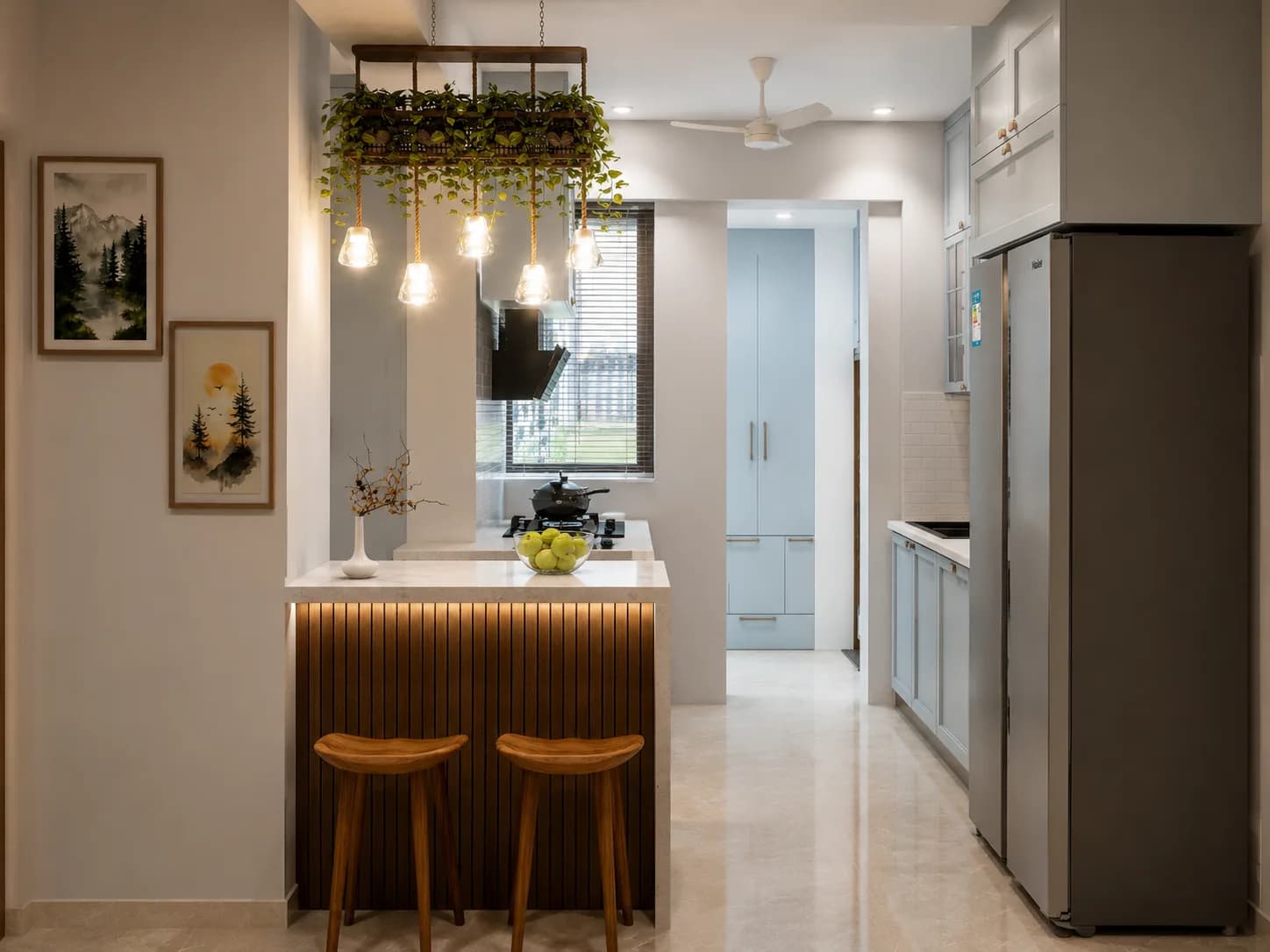
If you're planning a new kitchen in India, you will inevitably run into this debate. Your parents or contractor might insist that a traditional carpenter-made kitchen is stronger, cheaper, and more customisable. Meanwhile, every modern showroom will tell you that a factory-made modular kitchen is cleaner, longer-lasting, and far superior in quality.
The reality? Both have distinct advantages, and neither is the right answer for every single home. The decision comes down to your budget, your timeline, how long you plan to live in the home, and how much tolerance you have for on-site mess and noise.
At a glance: The 7-factor comparison
| Factor | Modular Kitchen | Carpenter-Made Kitchen |
|---|---|---|
| Manufacturing | Precision CNC machines in a controlled factory setting. | Hand-cut and assembled on-site by local carpenters. |
| Edge Banding | Machine-pressed edge banding with hot-melt glue; zero moisture seepage. | Manual edge strips stuck with adhesive; prone to peeling at corners over time. |
| Installation Time | 3 to 7 days on site (after 3–4 weeks of factory production). | 4 to 8 weeks of continuous cutting, hammering, and dust in your home. |
| Hardware & Fittings | Pre-engineered for soft-close tandem boxes, lift-ups, corner carousels (Hafele, Hettich, Blum). | Standard telescopic channels and regular hinges; advanced fittings require high carpenter skill. |
| Finish Quality | Flawless, seamless, uniform finish across every shutter and drawer. | Depends entirely on the individual carpenter's skill; visible imperfections common. |
| Cost (Average 10x10 ft) | ₹1.5 Lakh – ₹4.5 Lakh (depending on finish and hardware). | ₹80,000 – ₹2.5 Lakh (materials + carpenter labour charges). |
| Warranty | 5 to 10 years manufacturer warranty on carcass, shutters, and hardware. | No formal warranty; dependent on informal relationship with the contractor. |
1. Finish quality and precision
This is where modular kitchens have the clearest advantage. In a factory setup, panels are cut on computerized CNC machines with tolerances under 0.5 mm. Shutters align perfectly, gaps between drawers are completely uniform, and the edge banding is applied with industrial heat pressure that seals out humidity and water vapor.
With carpenter kitchens, even a master craftsman working with hand tools will produce slight variations in shutter gaps and edge adhesion. Over 3–5 years of exposure to boiling water, steam, and oil splatter, manually glued laminate edges are far more likely to peel or bubble around the sink and hob area.
2. The on-site experience: Timeline & dust
If you're already living in the apartment or renovating an occupied home, this factor alone often settles the debate:
- Modular: The design is finalized in 3D, measured with laser devices, and produced off-site. The actual delivery and assembly take between 3 and 7 days. Your home remains clean and quiet for 90% of the project duration.
- Carpenter: Raw plywood sheets, laminate cans, Fevicol, and saws arrive at your home. Your kitchen and living room become a dusty workshop for 4 to 8 weeks, with daily noise, chemical smell from adhesives, and debris throughout the house.
3. Real cost comparison (10-ft straight vs L-shaped layout)
Many homeowners assume carpenter kitchens are always 50% cheaper. When you factor in all the real costs, the gap is often narrower than you think:
| Component | Modular Kitchen (BWR Ply + Acrylic) | Carpenter Kitchen (Commercial/BWR Ply + Laminate) |
|---|---|---|
| Carcass & Shutters | ₹95,000 (Factory-finished, edge-banded) | ₹45,000 (Plywood sheets + laminates + adhesive) |
| Carpenter / Assembly Labour | Included in modular package | ₹35,000 – ₹55,000 (Daily/sq ft labour fee) |
| Hardware (Hinges, Drawers) | ₹35,000 (Branded soft-close channels) | ₹20,000 (Standard hardware bought from market) |
| Countertop & Sink Integration | ₹25,000 – ₹40,000 | ₹20,000 – ₹35,000 |
| Wasted Materials / Scraps | ₹0 (You pay only for finished modules) | ₹8,000 – ₹15,000 (Plywood and laminate offcuts) |
| Approx. Total | ₹1,55,000 – ₹2,10,000 | ₹1,28,000 – ₹1,75,000 |
Notice the hidden costs of carpenter kitchens: you pay for entire 8x4 ft plywood and laminate sheets even if your kitchen only needs 70% of the last sheet. In modular, factory nesting software optimizes sheet cutting across multiple orders, eliminating scrap costs for you.
4. Durability, water resistance, and longevity
Indian cooking involves heavy spices, high heat, deep frying, and frequent wet cleaning. Kitchen durability depends on three things:
- The core material: Always insist on Boiling Water Resistant (BWR - IS:303) or Boiling Water Proof (BWP/Marine - IS:710) plywood for the sink unit and carcass. Avoid particle board or standard MDF near wet zones.
- Edge sealing: Water seeping through unsealed raw edges is the #1 killer of kitchen cabinets in India. Factory edge-banding uses polyurethane glue that creates a watertight seal.
- Hardware protection: Moisture-resistant zinc alloy or stainless steel (SS 304) hinges prevent rust and sagging doors after 2–3 monsoons.
5. Modifications, repairs, and moving
- Modularity: If a pipe leaks and damages one bottom cabinet, with a modular setup you can unbolt and replace that single module without touching the rest of the kitchen. With a carpenter kitchen, cabinets are often built as one continuous wooden frame that requires major dismantling to repair.
- Relocating: If you move to a new apartment, modular units can technically be dismantled and reassembled (provided dimensions match), whereas a carpenter kitchen is permanently fixed to the walls.
Which one should you choose?
Choose a modular kitchen if:
- You want a flawless, high-end look with seamless acrylic, PU, or lacquered glass finishes.
- You are renovating an apartment you currently live in and cannot tolerate 6 weeks of sawdust and noise.
- You value manufacturer warranties (5–10 years) and guaranteed timelines.
- You want modern space-savers like tall pantry pull-outs, corner carousels, and bottle pull-outs that require precision hardware mounting.
Choose a carpenter kitchen if:
- You have an unusually irregular layout with awkward pillars, deep niches, or non-standard angles that standard modular boxes cannot easily fit.
- Your initial upfront budget is extremely constrained and you are comfortable using simpler manual fittings.
- You have a trusted family carpenter with proven craftsmanship who will personally build and maintain the woodwork for years.
The best of both worlds: Hybrid execution
Many smart Indian homeowners today choose a hybrid approach: they order the wet and high-usage zones (modular base cabinets, sink unit, and pantry) from a modular manufacturer for factory-sealed water protection, while using a carpenter for decorative panelling, open shelving, or unusual loft spaces. At Spazay, we offer end-to-end design and execution so you get the exact right combination of factory precision and custom on-site tailoring without having to manage separate vendors yourself.