
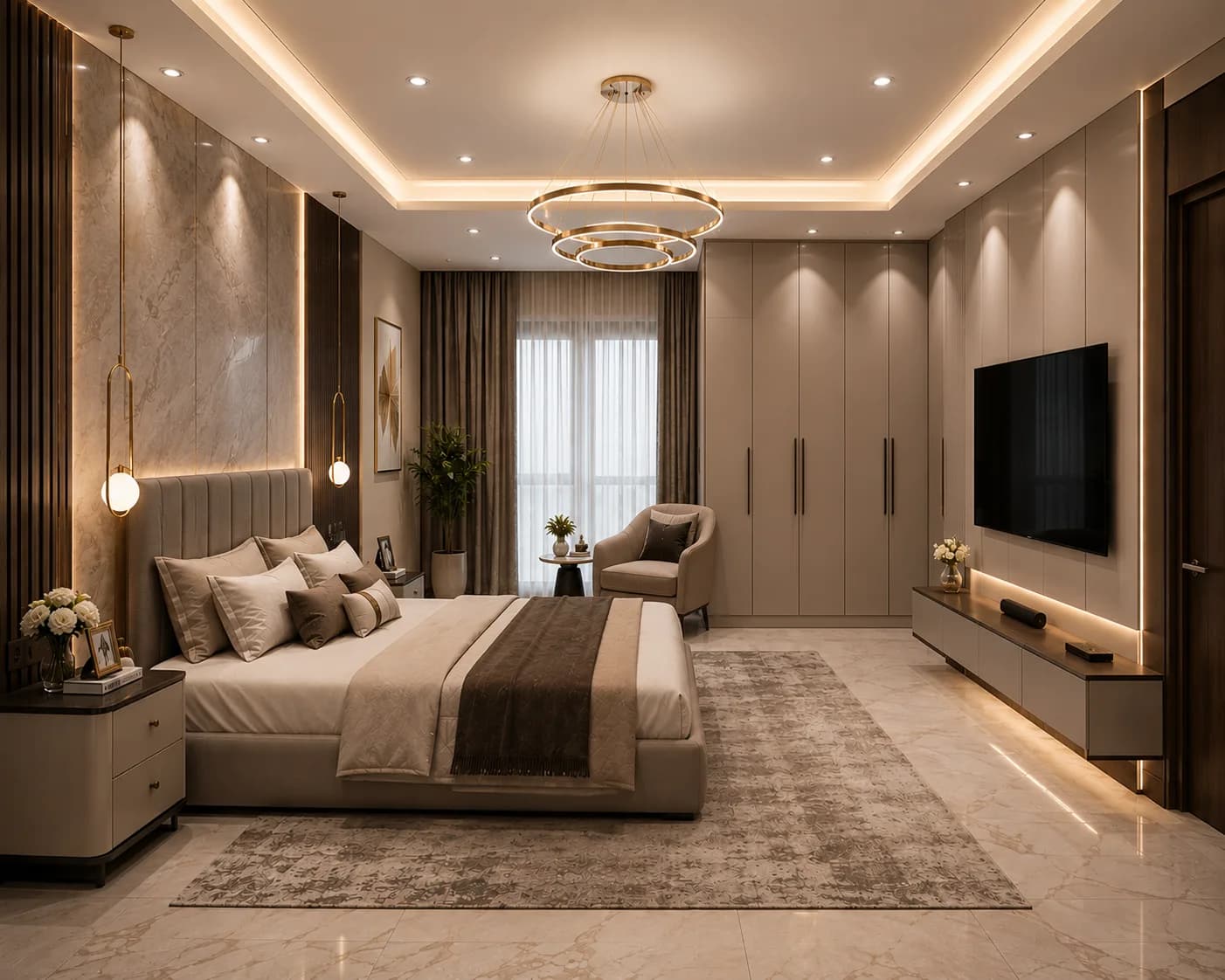
Ask five people in Gurgaon or Delhi NCR what their home interiors cost, and you'll get five completely different numbers from ₹4 lakh to ₹30 lakh. None of them are necessarily lying they're just describing entirely different projects with entirely different scopes, materials, and expectations.
The truth is, interior design cost in India isn't one number. It's a collection of choices about materials, finishes, room types, and how much custom work you need. This guide breaks down those costs as they stand in 2026, room by room and rupee by rupee, so you can build a realistic budget before you sign a single contract.
The short answer: Per sq ft rates at a glance
Most interior designers and companies quote on a per square foot basis for initial estimates. Here's what those tiers look like in 2026 across major Indian cities, including Delhi NCR, Mumbai, Bengaluru, and Hyderabad:
| Tier | Cost per sq ft | What's included | Best suited for |
|---|---|---|---|
| Basic / Essential | ₹1,200 – ₹1,800 | Commercial ply, basic laminate finish, standard modular kitchen, essential wardrobes, basic electrical points, paint. | Rental properties, tight budgets, first-time homeowners. |
| Standard / Mid-Range | ₹1,800 – ₹2,500 | BWR / Marine-grade plywood, textured/acrylic laminates, quartz countertops, false ceiling with cove lighting, custom entertainment unit, branded hardware (Hettich / Hafele basic). | Most 2BHK and 3BHK end-use apartments, balanced aesthetics and longevity. |
| Premium / Luxury | ₹2,500 – ₹5,000+ | Full marine ply, veneer or PU finish, imported marble / granite, designer false ceiling, smart lighting, high-end hardware, custom panelling, bespoke loose furniture. | Villas, luxury apartments, homeowners wanting a fully bespoke, high-finish home. |
Note: These figures generally cover fixed woodwork, civil work, electrical, false ceiling, and painting. Loose furniture (sofas, dining sets, mattresses) and electronics are usually quoted separately unless you opt for a fully turnkey package.
Full-home interior costs by apartment size (BHK)
For a complete home interior project covering living room, kitchen, bedrooms, bathrooms, and utility areas here is the realistic budget range you should expect in 2026:
| Apartment Size | Carpet Area (approx.) | Basic | Standard | Premium |
|---|---|---|---|---|
| 1 BHK | 400 – 600 sq ft | ₹4.5 – ₹6.5 Lakh | ₹7 – ₹10 Lakh | ₹11 – ₹16 Lakh |
| 2 BHK | 750 – 1,050 sq ft | ₹7 – ₹10 Lakh | ₹11 – ₹16 Lakh | ₹17 – ₹25 Lakh |
| 3 BHK | 1,200 – 1,600 sq ft | ₹10 – ₹15 Lakh | ₹16 – ₹23 Lakh | ₹24 – ₹38 Lakh |
| 4 BHK / Villa | 1,800 – 2,500+ sq ft | ₹16 – ₹22 Lakh | ₹24 – ₹35 Lakh | ₹38 – ₹60 Lakh+ |
Room-by-room cost breakdown
To understand where your money actually goes, it helps to look at each space independently. The kitchen and master bedroom almost always account for 50–60% of your total interior budget.
1. Modular Kitchen (₹1.5 Lakh – ₹6 Lakh+)
The kitchen is the most hardware-intensive and cost-dense room in the house:
- Basic modular kitchen: ₹1.5L – ₹2.5L (Laminate finish, commercial ply/MDF, basic stainless-steel wire baskets, standard granite counter).
- Mid-range modular kitchen: ₹2.5L – ₹4L (BWR/Marine ply, acrylic or PU finish shutters, soft-close tandem boxes from Hettich/Hafele, quartz counter, chimney/hob integration).
- Premium modular kitchen: ₹4L – ₹7L+ (Solid acrylic/lacquered glass shutters, marine-grade carcass, automated lift-up cabinets, tall pantry units, premium quartz or Dekton surface, built-in appliances).
2. Living and Dining Room (₹1.5 Lakh – ₹5 Lakh)
Your living area sets the tone for the entire home:
- TV unit / Entertainment wall: ₹35,000 – ₹1.2L (Laminate panel with storage vs fluted panel with marble/stone-look laminate and warm backlighting).
- False ceiling + Lighting: ₹40,000 – ₹90,000 (Gypsum board ceiling, COB spotlights, magnetic track lights, LED strip profiles).
- Foyer / Shoe rack unit: ₹20,000 – ₹60,000 (Compact console vs floor-to-ceiling shoe storage with seating and panelling).
- Wall treatments / Panelling: ₹25,000 – ₹1L (Texture paint, wallpaper, louvres, or veneer panelling).
3. Master Bedroom (₹1.8 Lakh – ₹4.5 Lakh)
The master bedroom requires significant storage and higher-finish surfaces:
- Floor-to-ceiling wardrobe: ₹80,000 – ₹2.2L (Sliding vs hinged, mirror inserts, sensor-lit drawers, acrylic or PU finish).
- Bed with storage & headboard: ₹45,000 – ₹1L (Hydraulic lift storage, upholstered headboard wall).
- Dresser / Vanity unit: ₹20,000 – ₹55,000 (LED mirror, dedicated accessory storage).
- False ceiling & side tables: ₹30,000 – ₹75,000.
4. Kids / Guest Bedroom (₹1.2 Lakh – ₹2.8 Lakh per room)
Typically simpler, with modular wardrobes, a study desk setup, and durable laminate finishes.
5. Bathrooms & Utility (₹50,000 – ₹2 Lakh per bathroom)
Covers vanity cabinets with quartz tops, under-sink storage, mirror cabinets with integrated lighting, glass shower partitions, and anti-skid tile overlays if required.
What really drives the cost? 5 major factors
- Carcass and shutter materials: The choice between commercial MR ply, BWR ply, Marine grade (BWP) ply, and HDHMR can shift costs by 20–35% across the project.
- Surface finishes: Matte laminate is cost-effective; high-gloss acrylic, PU paint, and natural wood veneer add substantial polish and cost.
- Hardware and fittings: Standard channels vs soft-close tandem boxes and Blum/Hettich hinges represent a 15–20% swing in woodwork costs.
- Civil changes and structural work: Breaking walls, rerouting plumbing, tiling, and re-wiring add variable costs that depend on site condition.
- Design complexity: Fluted panels, curved arches, CNC cutwork, and concealed profiles require more craftsman-hours than clean linear designs.
Hidden costs to watch out for before signing
- GST: Confirm whether it's included or added on top.
- Site handling or supervision charges: Clarify if management fees are baked in.
- Costs "on actuals": Keep an eye on line items not yet finalised.
- Design modification fees: Charges for mid-project design changes.
- Exclusions: Loose furniture, electronics, and decor are often excluded from the base quote entirely.
- Contingency buffer: Maintain a 10–15% buffer of the total for unforeseen site issues.
A quick word on getting quotes that actually compare
Two quotes for the "same" 2BHK can differ by ₹5 lakh and both be honest they're just scoped differently. Before comparing numbers, make sure every quote lists the same plywood grade, the same finish, the same inclusions, and the same exclusions. Anything less, and you're not really comparing prices at all.
This is really the whole point of an itemised BOQ it's the one document that turns "trust me" into something you can actually check, line by line, before you sign anything. At Spazay, that's the number we hand over before construction starts, not somewhere after it. If you'd rather see a real estimate for your own home than keep comparing averages, talk to a Spazay designer and get a written quote you can actually read.